What will a city look like 160 years from now?
CITY 2186 began with that simple question.
Rather than designing a single futuristic skyline, the idea was to imagine the whole place — where people live, how they travel, where their food comes from, how the city produces energy, where things are manufactured, and eventually how its inhabitants leave Earth.
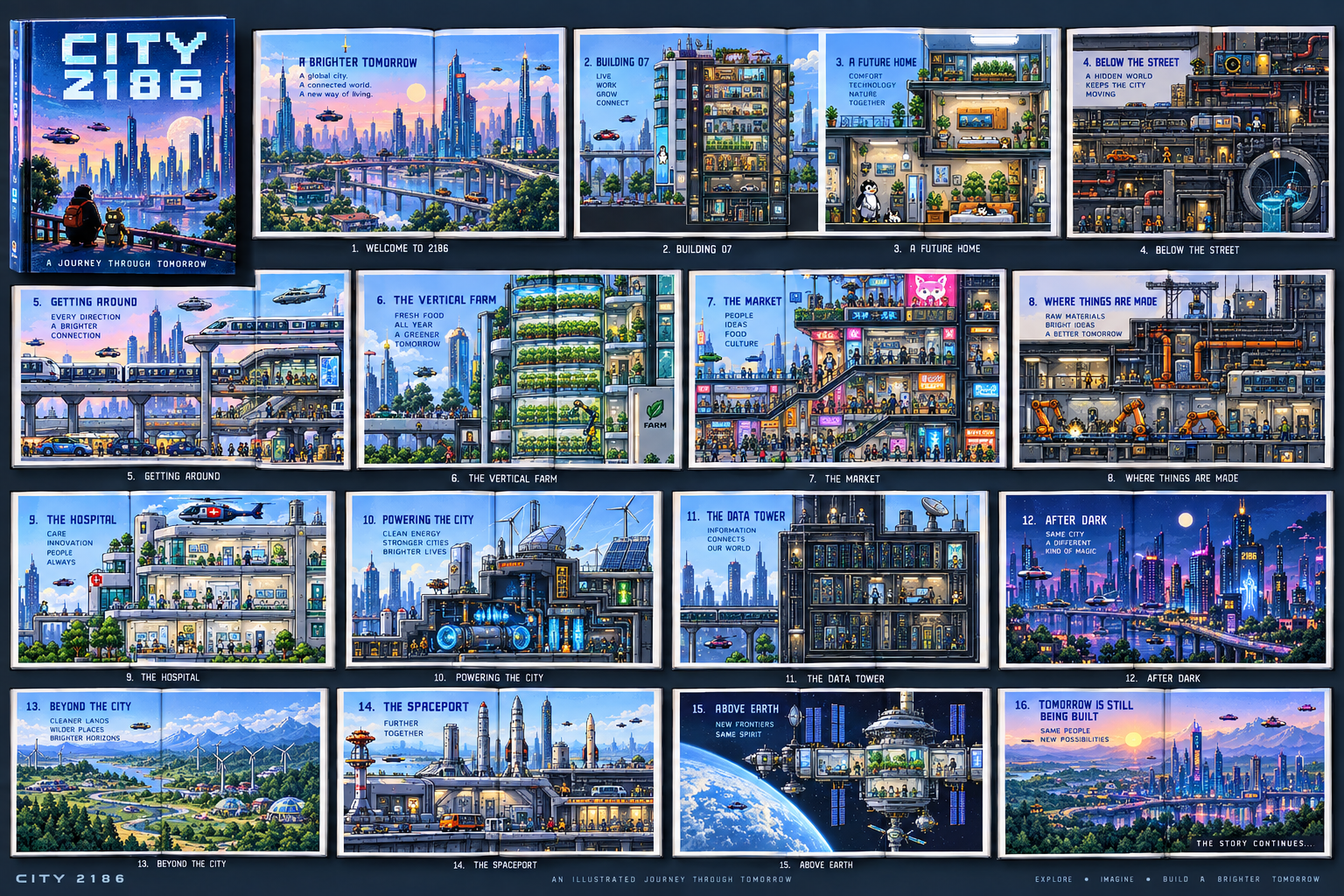
The result is CITY 2186: A Journey Through Tomorrow — sixteen interconnected pixel-art scenes forming a visual tour through a possible future.

A city, not just a skyline
The interesting part of building CITY 2186 was treating the city as a functioning world. The blueprint moves through homes, underground transport, vertical farming, markets, manufacturing, healthcare, energy production, data infrastructure and life after dark before travelling beyond the city towards a spaceport and Earth orbit.
Each scene can stand alone, but together they suggest a much larger place beyond the edges of the image.
Sixteen windows into 2186
The whole project was designed at miniature scale first. That makes it possible to see the rhythm of an entire illustrated book in a single image: quiet interiors beside enormous city views, technology beside nature, and everyday life beside the spectacular.
Instead of hiding that development stage, we think the blueprint deserves to be seen as artwork in its own right. You can zoom in, follow the journey and begin imagining what might exist between the sixteen scenes.
Building a brighter tomorrow
CITY 2186 isn’t intended as a prediction. It is visual world-building: an experiment in asking what a future city could contain and then trying to make that world feel coherent enough to visit.
The miniature blueprint also gives us a choice. It can remain a single giant piece of concept art, or one day each scene could be expanded into a full illustrated page — the same process used to develop other Oilfuel projects.
Explore more books, experiments and illustrated worlds in The Oilfuel Document Library.
Leave a Reply