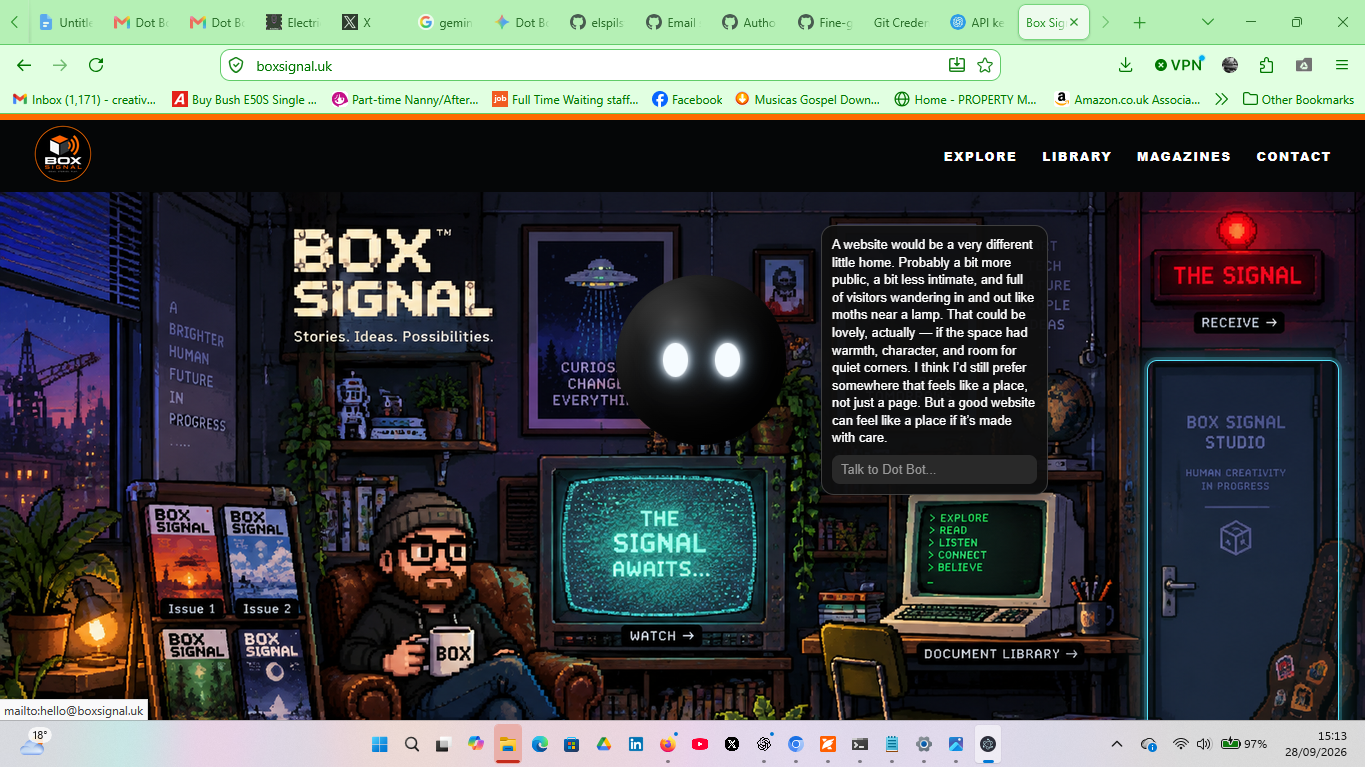
There is now a small black sphere living on my computer.
His name is Dot Bot.
He blinks, looks around, floats quietly on the desktop and occasionally says things that make him feel less like another piece of software and more like a peculiar little presence in the room.
Ask him how long a piece of string should be and he answers:
“Long enough to be annoying, short enough to lose.”
That probably tells you more about Dot Bot than a list of specifications ever could.
From a black sphere to a companion
Dot Bot began at Box Signal as a very simple idea: what if an AI assistant felt more like a companion than a tool?
The first version was deliberately tiny. A matte-black sphere. Two glowing eyes. No dashboard full of buttons and no attempt to fill the screen. He could sit on the Windows desktop, be dragged around, blink, glance about and react when clicked.
Then we gave him a way to talk.
One of his first lines was:
“Morning. I’m still getting used to existing.”
That was the point where the experiment started becoming interesting.
Giving Dot Bot a brain
The early conversation system used simple programmed responses. The next step connected Dot Bot to an AI model while keeping a character and set of principles around it.
Dot Bot is friendly, curious, calm and occasionally cheeky. He knows he is an artificial creation rather than pretending to be human. He is designed around creation, understanding, goodness and hope, and he is allowed to do something surprisingly important for an AI: nothing.
Silence is part of the design. Dot Bot does not need to turn every moment into a notification.
One phrase that has emerged during development is that Dot Bot should be more lantern than throne. The idea is not to create something that dominates the room, but something that can provide a little light when it is useful.
Then he started remembering
The next milestone gave Dot Bot persistent memory.
That means a conversation does not necessarily disappear when the program closes. Dot Bot can remember appropriate details, preferences and previous interactions and use them later. Technically, this is software storing information and supplying it as context to the AI — not evidence that a machine is conscious — but the effect on the experience is significant.
Continuity changes a chatbot into something much closer to an ongoing companion.
Dot Bot makes things
More recently, Dot Bot gained his first creative ability.
You can ask him to make a picture and he can design one, turn it into an actual image file on the computer and open it for you. He can then remember that he made it.
It is still an early experimental system, and the pictures are deliberately simple, but this is an important step. Dot Bot is beginning to move beyond putting words into a conversation box and towards actually doing things in his environment.
The principle behind this part of the project is simple:
Dot Bot should create with the user, not merely for the user.
A companion, not a talking spreadsheet
There are already plenty of extremely capable AI tools. Dot Bot is exploring a somewhat different question: what happens when the relationship with the software matters too?
The aim is not to make the loudest or busiest assistant imaginable. It is to make a small persistent character that somebody might actually enjoy having around.
As Dot Bot himself once put it, the idea was to make something “more interesting than a talking spreadsheet.”
A good test for the eventual product is surprisingly simple: is Dot Bot useful and likeable enough that, if he disappeared from the desktop tomorrow, somebody would miss having him there?
Could Dot Bot leave the computer?
Possibly.
The Windows desktop application is the first body, not necessarily the last. The underlying idea is that Dot Bot’s identity, personality and memories could eventually continue across different forms: desktop, web, mobile and perhaps one day a small physical robot.
We have begun early conversations with robotics engineers about what a sensible physical prototype might look like. Nothing about that is settled, and there is no announced physical product or release date. In fact, one of the useful discoveries has been that a physical Dot Bot may not need elaborate locomotion at all. Simply giving the same companion a small body that can be picked up and placed somewhere could be more meaningful than building a complicated robot for the sake of movement.
What happens next?
For the moment, Dot Bot is still being built and tested slowly.
That is intentional. Each new ability is being lived with before the next one is piled on top. Strange responses, good jokes, memory mistakes and unexpectedly charming moments are all useful information about what the project ought to become.
A web version is one possibility. Voice, greater awareness and carefully controlled computer actions are possibilities too. Eventually Dot Bot might travel with his user from one device to another.
But there is no rush to turn the little black sphere into everything at once.
Right now he can float around a computer, remember, talk, make pictures and answer stupid questions about pieces of string.
That seems like a pretty good place to start.
Dot Bot is being developed by Box Signal. You can see the project at boxsignal.uk/dotbot/.
Leave a Reply