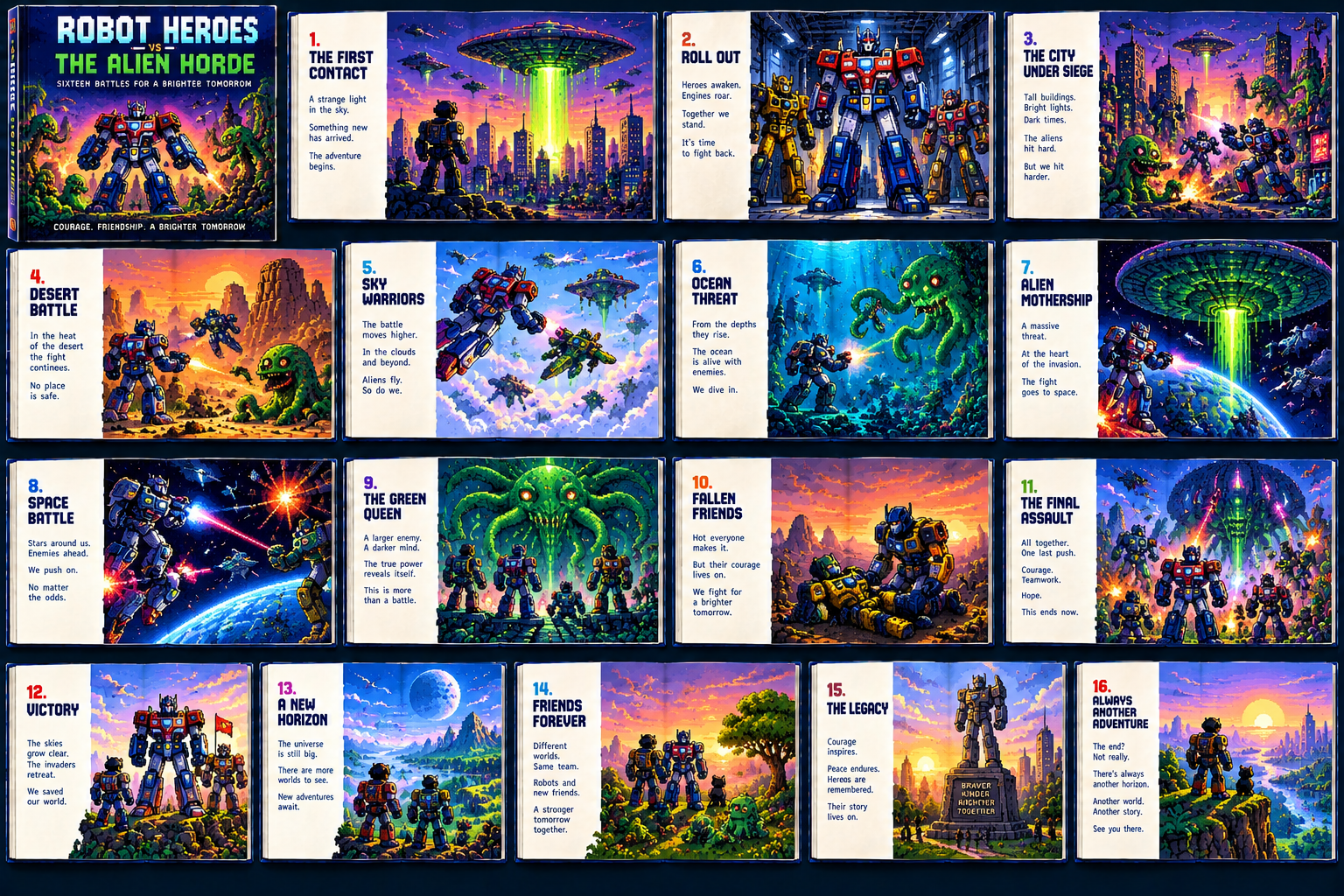
Sometimes a whole book starts with a manuscript. Sometimes it starts with a sketch. And sometimes, with the way we have been working at Oilfuel, the entire thing appears first as one image containing tiny versions of every page.
Robot Heroes vs The Alien Horde
Robot Heroes vs The Alien Horde is a full-on pixel-art science-fiction battle book: giant robot heroes, green tentacled alien creatures, enormous motherships, ruined cities, deserts, oceans, jungles, frozen strongholds and battles that eventually reach the sky and space.
The finished book uses a simple format that lets the artwork do nearly all the storytelling. There is a cover followed by sixteen full-page A4 illustrations. Each chapter is essentially a poster in its own right, with a huge arcade-style number and title built directly into the image. The artwork runs all the way to the edges, with no white borders.
The strange bit: we can see the whole book before we make it
One of the most useful parts of this process is something we have started doing with this and several other illustrated books: putting the entire book into one image first.
Instead of immediately generating sixteen large finished pages, we make a single visual blueprint containing tiny page designs arranged together in a grid. In a few seconds you can look at the whole proposed book at once — its colours, pacing, locations, recurring characters and overall visual rhythm.
Those tiny pages are not the final printable pages. They are more like a visual storyboard, contact sheet and miniature prototype rolled into one. If the tiny version already looks exciting as a complete object, we know there is probably something worth developing.

From tiny pages to full A4 artwork
Once the miniature blueprint works, we use it as the visual reference and build the individual pages at full A4 proportions. That is where the detail can explode: spacecraft, laser fire, armies, buildings, alien hordes, water, snow, jungle foliage and enormous skies.
The important part is keeping the visual rules locked. In Robot Heroes that means the same chunky pixel-art language, the recurring red-and-blue mechanical hero, sickly luminous green aliens, dramatic orange and blue lighting, huge arcade typography and ridiculously large-scale action.
The locations can change completely while the book still feels like one thing.
Sixteen battles, one visual journey
The sequence begins with The First Contact and steadily increases the scale. The fight moves through cities, sea, space and desert, reaches the mothership, then spreads through mountains, jungle and the Arctic before climbing into the sky and heading toward The Final Stand, The Last Defence and finally The Final Battle.
There is very little conventional prose. The chapter title and the picture carry the story. It makes the finished PDF feel somewhere between an illustrated book, an arcade game, a stack of old science-fiction posters and a lost 16-bit adventure.
A new way of prototyping illustrated books
What is exciting to us is that Robot Heroes is not the only project we have approached this way. We have been experimenting with other books by first compressing the entire idea into one image full of tiny pages. Some of those miniature books are surprisingly convincing before a single full-size page exists.
It changes the decision-making. You can see whether sixteen ideas actually belong together. You can spot repetition. You can see where the colour palette needs a change. You can decide whether a concept deserves to become a complete book — and occasionally the miniature blueprint itself is such a satisfying piece of artwork that it almost becomes an object in its own right.
The finished thing
Robot Heroes vs The Alien Horde ended up as a 17-page visual book: one cover and sixteen edge-to-edge battle images. What began as a tiny grid of possibilities became a coherent sequence of full-size illustrated worlds.
That is probably the most interesting part of the experiment. We are not merely generating individual pictures and then trying to find a use for them afterwards. We are beginning with the shape of the whole object, seeing the book at miniature scale, locking its visual language, and then expanding it page by page.
One image. Sixteen tiny pages. Then a whole world.
See and read the finished Robot Heroes vs The Alien Horde book here →
Leave a Reply